
For a first game, remember this order: check whose turn it is, roll, bring in any checker on the bar first, use both numbers, and start bearing off only after all 15 checkers are in your home board.
30-second quick start
If you want to begin right away, you do not need to memorise the whole page. Follow these five steps and you can finish a first game:
- White always moves first. If you choose Black, the AI makes the opening roll.
- Each turn you roll two dice and usually must play both numbers. Doubles let you play that number four times.
- If you are unsure what to move first, check the bar. A checker on the bar must reenter before anything else moves.
- A point with one checker is a blot. Landing there hits it to the bar.
- You may bear off only after all 15 checkers are in your home board. The first player to bear off all 15 wins.
For a first game, focus on spending both numbers. You do not need to build a perfect prime before you start.
Opening setup
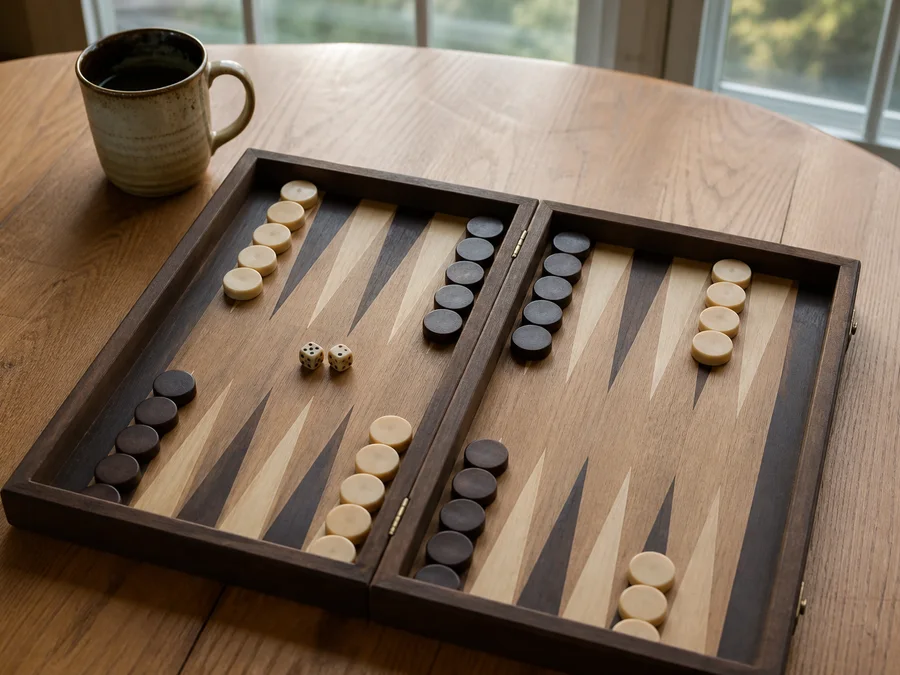
The board has 24 points in all, 12 on each side. White runs from 24 toward 1; Black runs the opposite way. Each player starts with 15 checkers in the standard layout: two on the 6-point, three on the 8-point, five on the 13-point, and two on the 24-point. The six points nearest the side where you bear off are your home board. If you know which way your side runs and where your home board is, you are ready to start.
How dice work
On your turn you roll two dice. Each number is one move: with 5 and 3 you may move one checker 5 then 3, or two checkers 5 and 3. If one checker uses both dice, the intermediate stop after the first number must also be legal. Doubles let you play that number four times.
A checker may land on an open point, a point you already occupy, or a blot. A point with two or more enemy checkers is blocked. When both dice can be used, you must use both. If only one die can be played, you must use the higher one. If neither can be played, the turn is skipped.
Hitting, the bar, and reentry
A lone checker is a blot. Land on that point and it goes to the bar. While you have a checker on the bar, you must reenter it in the opponent's home board before moving anything else. Dice 1 through 6 match the six entry points there, and the destination must be open, friendly, or a blot.
If you cannot reenter, you skip the rest of the turn. Extra checkers on the bar must also reenter first. If your reentry lands on a blot, that enemy checker goes to the bar as well.
Bearing off and winning
You may bear off only after every checker is in your home board. A die that matches a point lets you remove a checker from that point. If that point is empty, and there are no checkers on higher points, you may bear off the checker from the highest occupied lower point instead. The first player to bear off all 15 checkers wins.
If you finish while the opponent has borne off none, the game is a gammon. If the opponent still has a checker in your home board or on the bar, it is a backgammon. Players may agree a draw. This site has no doubling cube and does not keep match scores.
How to play here
Check the status bar for the side to move, roll, then tap the checker you want to play. If you have a checker on the bar, bring it in first. The board blocks illegal landings for you. Against AI you may sit White or Black, and hints follow the current level.
If you are not sure what to do, ask three questions in order: do I need to reenter from the bar, how do I use both numbers, and will this move leave a blot? Once all 15 of your checkers are in the home board, switch to bearing off. After one full game, continue to the backgammon strategy guide.
Backgammon Rules FAQ
Which side moves first in backgammon?
White always moves first. Against AI you may choose White or Black; if you choose Black, the AI makes the opening roll.
Can one checker use both dice?
Yes, as long as each step is legal. With 5 and 3, one checker may move 5 then 3, but the point after the 5 must also be open.
Why do doubles allow four moves?
When both dice show the same number, that number may be used four times. Two 4s, for example, give four moves of 4.
Can I move on the board while I still have a checker on the bar?
No. You must reenter first. If you cannot reenter, the rest of the turn is skipped.
What if only one die is playable?
You must use the higher die. The turn is skipped only when neither die can be played at all.
Can I bear off before every checker is in my home board?
No. All 15 checkers must be in your home board before any checker may be borne off.
Does this site use a doubling cube?
No. Each game is a single race to bear off. There is no doubling cube and no match scoring.
